

Menopause, hormones and hair loss: Why it occurs and what to do about it
Menopausal hair shedding and thinning affects over 50 per cent of women - find out what causes it and solutions that may help

Published in

For many women, menopause doesn’t just bring hot flushes and mood swings, it can have a noticeable impact on their hair, too. Yet hair loss is rarely discussed as openly as other concerns, leaving many women feeling isolated and unsure whether their symptoms are normal (and if they can be treated).
To better understand what’s happening, I spoke to Dr Manav Bawa, medical director at Time Clinic, and Kelly Morrell, scalp specialist and founder of Scalp Confidential, both of whom regularly treat midlife women experiencing hair thinning.
“The headline change is falling estrogen and progesterone,” explains Dr Bawa.
“Hair follicles are very hormonally sensitive; as estrogen falls, many women experience a shift toward a relative androgen effect at the follicle. This can contribute to follicle miniaturization and a higher tendency to shed.”
Kelly sees this daily in-clinic. “Approximately 50 per cent of my clients are over 40 and experiencing hair thinning of some kind,” she says. The reassuring part? While common, menopausal hair thinning isn’t beyond intervention. From hormone replacement therapy (HRT) and nutritional support to products which can help improve the appearance of thinning hair, there are now multiple approaches available, including CALECIM® Hair Serum.

Used both in specialist clinics and at-home, the system combines a topical serum containing PTT-6® exosomal proteins with a medical-grade dermastamper. The controlled micro-stamping technique creates temporary micro-channels in the scalp to enhance delivery of the serum, which can help improve the appearance of thinning hair.
What menopause does to the hair growth cycle
According to Dr Bawa, two key processes are at play during menopause: miniaturization and cycle disruption. “A common theme is female pattern hair loss, which is often realized as a widening central parting, crown thinning or temple recession,” he explains. “Miniaturization means thicker terminal hairs progressively convert to finer hairs. At the same time, more hairs shift into the resting or shedding phase.”
Reduced estrogen is central to this shift. “Clinically, reduced estrogen is associated with a shorter growth phase and relatively more hairs entering shedding,” he says. “Women often say: ‘I’m shedding more,’ and ‘What grows back is finer.’”
Kelly sees these changes reflected in patient experience. “The scalp appears more visible, partings widen, shedding occurs in varying degrees,” she says. “Hair texture can change: hair can become drier, less voluminous, lacklustre, frizzy, finer or limp.”
Importantly, she notes the emotional impact. “Hair is closely tied to identity, femininity and perceived vitality,” she says. “In midlife, hair loss can feel like a visible loss of self.”
Understanding the biology behind these changes is the first step toward deciding what kind of intervention may help.
HRT, nutrition and a layered approach

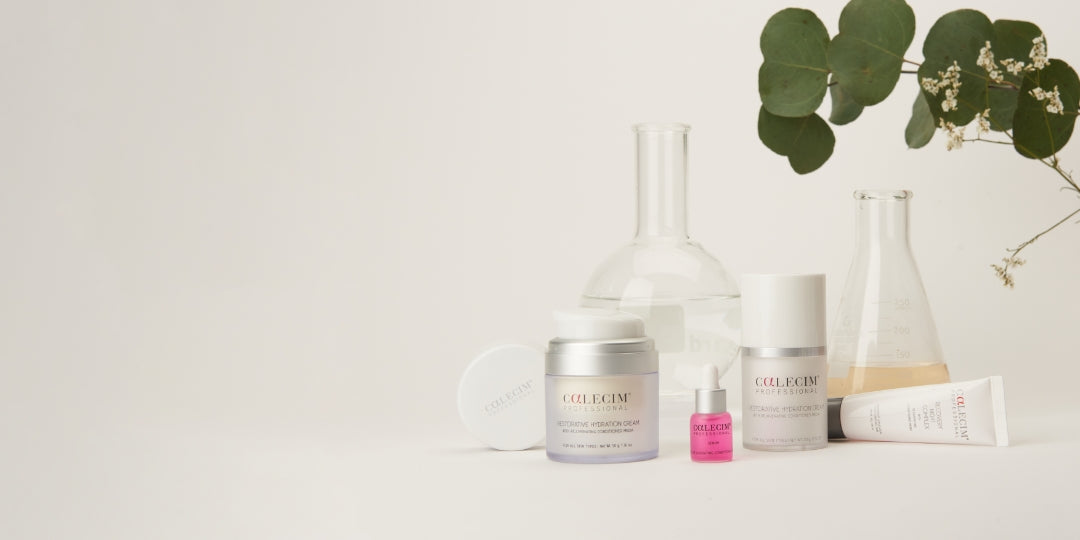
Discover layered support, from HRT to nutrition and topical products (CALECIM® Professional)
While declining estrogen is central, both experts stress that more factors are often at play when it comes to midlife hair thinning. “HRT can help some women, but I wouldn’t call it reliably ‘hair-restorative’ as a standalone,” says Dr Bawa. While stabilizing hormones may improve the scalp environment, “pattern hair loss and miniaturization often still need targeted follicle support.”
Also, notes Dr Bawa: “Midlife hair loss is rarely ‘just hormones’. Stress and poor sleep can push follicles into a shedding phase. Protein or calorie insufficiency is also very common. Hair is a ‘non-essential’ tissue, so the body deprioritizes it during stress or deficit.”
Micronutrients matter, too. “Iron stores, ferritin, vitamin D, B12, folate, zinc and thyroid dysfunction can mimic or worsen menopausal shedding,” he explains.
A combined approach is something Kelly actively supports in clinic. “Clients often assume once they start HRT their hair will completely recover,” she says. “In reality, many still need direct follicle stimulation and scalp support.”
Kelly agrees that layered support is key. “If we don’t address what’s happening internally, topical treatments alone won’t be enough,” she says. “But equally, supporting the follicle directly can make a significant difference.”
How targeted support can help those with hair loss

The CALECIM® system uses a topical serum applied with a dermastamper device (CALECIM® Professional)
In 2025, Dr Bawa revealed the results of an evaluation of 12 perimenopausal women using the CALECIM® Hair Serum, with the majority of results achieved through at-home application using the supplied dermastamper device. Results typically started to become noticeable between weeks six and 12. “I saw a visible improvement across participants,” he says, “With many reporting improved confidence and external feedback that their ‘hair looks thicker/healthier.’”
The CALECIM® system centers on PTT-6®, which Dr Bawa describes as “a complex blend of signaling proteins derived from umbilical cord lining stem cells.”
The treatment can be delivered in-clinic for those who prefer professional oversight (particularly patients who may also require bloodwork, hormone monitoring or diagnostic scalp assessment) but it’s equally structured for at-home use with guided micro-stamping to enhance delivery.
In terms of suitability, Dr Bawa notes it can be used in both male and female pattern thinning, provided follicles are still present and scarring alopecia has been ruled out. Side effects are generally mild. “Typically any reaction relates to the micro-stamping – temporary redness, tenderness or short-lived scalp sensitivity,” he says. The serum itself is well tolerated, including among those with sensitive skin.
And results can be impressive: by week six, nine out of 10 participants who completed the assessment reported improvements, including observations of improved hair thickness and enhanced volume at the hairline and temples.
At 12 weeks, all patients who completed the study reported that their hair appeared thicker. While the study was limited by its small sample size and did not include objective measures such as hair counts or trichoscopic imaging, the participants consistently reported improvements.
For women navigating midlife shedding, the message from both experts is consistent: optimize hormones and lifestyle where appropriate, but consider other products, such as CALECIM® Hair Serum. As Kelly puts it, “When patients hear their hairdresser say their hair looks denser, the shift in confidence is often just as important as the physical change.”
Explore the CALECIM® Hair Serum and find out whether it could be right for you at CALECIM®


.jpg?v=1757918410324)